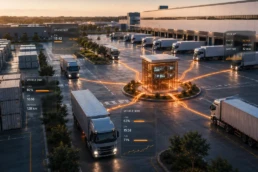
By 2026, the supply chain will no longer be just a cost center. Instead, it will be the primary driver of business resilience and competitive advantage. The days of purely “just-in-time” efficiency are giving way to a new era defined by autonomy, authenticity, and antifragility.
Leading analyst firms like Gartner, Forrester, and ISG have signaled a massive structural shift. We are moving away from systems that simply predict disruption to intelligent networks that can act on it autonomously. As geopolitical lines harden and sustainability mandates tighten, the supply chain of 2026 will look fundamentally different: smarter, more local, and rigorously verified.
Explore the Top 5 Supply Chain Trends shaping operations and strategy in 2026.
1. From Prediction to Action: The Rise of “Agentic” AI
For the last decade, AI in supply chain management has been largely advisory. It crunched numbers to tell a planner, “You might run out of stock next week.” In 2026, that dynamic flips.
According to Gartner, we are entering the age of Agentic AI. Unlike passive chatbots, these are autonomous agents capable of reasoning and execution. Instead of just flagging a potential port delay, an AI agent in 2026 will autonomously re-route shipments, negotiate spot rates with carriers, and update inventory allocations, all within pre-set risk guardrails.
This digital intelligence is also taking physical form. “Physical AI,” comprising advanced robotics and drones, is moving from “pilot purgatory” to “hard hat work,” as Forrester describes it. We will see warehouses where autonomous mobile robots (AMRs) do not just follow pre-programmed paths but sense changes in their environment and adapt workflows in real-time. The goal is no longer just automation but autonomy.
2. Geopatriation: The Retreat to Sovereign Networks
The era of unfettered globalization is yielding to a new reality of “Geopatriation.”
Supply chain leaders are realizing that data sovereignty is just as critical as physical inventory. Gartner predicts that by 2030, over 75% of enterprises in regions like EMEA will “geopatriate” their workloads to ensure control. In 2026, this trend accelerates as companies move critical operational data and intellectual property into “sovereign clouds,” which are local infrastructures protected by national borders.
This digital retreat mirrors physical “friend-shoring.” Manufacturers are continuing to shift capacity from low-cost, high-risk regions to politically aligned hubs. However, as ISG notes, this flight to safety comes at a price with tighter markets and rising costs in safe-haven logistics hubs. The supply chain of 2026 prioritizes jurisdictional safety over the absolute lowest unit cost.
3. The Era of Authenticity: Circularity as an Operation
Sustainability is leaving the marketing department and entering the operations room. By 2026, vague “green” promises will be liabilities. Forrester calls this the “Era of Authenticity,” where companies face a reckoning if their claims cannot be mathematically proven.
The driver here is regulation, such as the EU’s Digital Product Passport (DPP). These mandates are forcing a shift from linear “take-make-waste” models to circular supply chains. Everest Group highlights that “reverse logistics,” the process of handling returns, repairs, and recycling, will become as sophisticated as outbound shipping.
In 2026, waste is an asset. Companies will compete with their ability to mine their own products for raw materials, reducing dependency on volatile commodity markets. Authenticity means that every step of this green journey must be verifiable, traceable, and auditable.
4. Digital Provenance: The Trust Economy
In a world flooded with AI-generated content and sophisticated counterfeits, Trust is the new currency.
Gartner identifies Digital Provenance as a critical trend. As supply chains digitize, the risk of “fake” data, whether from cyber spoofing or AI hallucinations, explodes. To combat this, leaders are implementing technologies like blockchain and cryptographic watermarking to create immutable audit trails.
This is the “Trust Economy.” Procurement in 2026 won’t just ask “How much?” but “Can you prove it?” Buyers will demand irrefutable proof of origin for everything from the cobalt in a battery to the labor practices in a factory. As ISG notes, supplier risk indexes are becoming the central dashboard for procurement, prioritizing transparency over pure speed.
5. The Antifragile Workforce
The labor shortage in logistics is structural, not temporary. There are simply not enough humans to move every box the world wants to ship. The solution in 2026 is “Antifragility,” defined as building systems that get stronger under stress.
This requires a new economic model for labor. ISG predicts the rise of “Autonomy-Level Pricing,” a shift where companies pay vendors for outcomes (e.g., “99% on-time delivery”) rather than for hours worked. This decouples growth from headcount, allowing supply chains to scale up without frantically hiring during peaks.
Simultaneously, the human role is elevated. The warehouse worker of 2026 is less a “picker” and more a “fleet manager,” overseeing the teams of robots that do the heavy lifting. The workforce is smaller, but significantly more skilled and tech enabled.
Conclusion: The Road Ahead
The supply chain of 2026 is not for the faint of heart. It requires letting go of old certainties, such as the reliability of global trade routes or the availability of cheap labor.
However, for organizations that embrace these trends, the reward is immense. By leveraging Agentic AI, securing their sovereign data, and committing them to authentic circularity, companies can build supply chains that do not just survive the next crisis but thrive because of it. Join hands with Innover an ISG recognized supply chain partner to traverse the evolving landscape powered by experience and intelligence.